
Research Behind CAPIT's Handwriting Component Design
The Primary Purpose of Handwriting in CAPIT
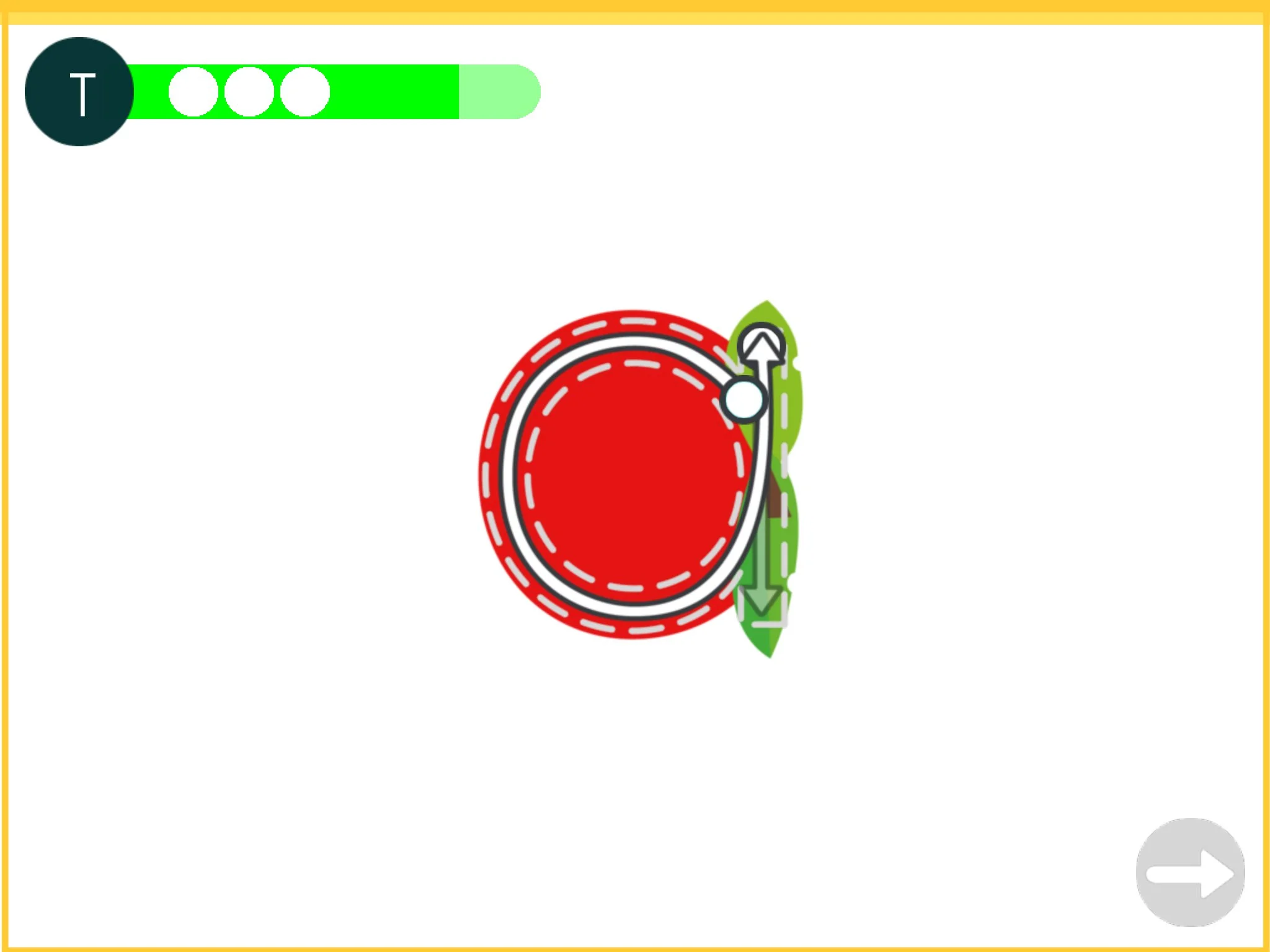
Fig. 1: Handwriting Interface
First, it's important to clarify that our primary goal in including the handwriting interface in Levels 1 and 2 is not to teach penmanship or perfect letter formation. Rather, we use handwriting as an additional modality to help students establish sound-to-symbol correspondence. There is substantial research showing that the act of writing letters—tracing their shapes with one's own hand—significantly improves letter recognition and retention compared to passive observation alone (James & Engelhardt, 2012; Longcamp et al., 2005).
The multimodal approach (seeing, hearing, saying, and writing) strengthens the neural pathways that connect sounds to their written representations, which is our core instructional goal.
Developmental Considerations and Accessibility
Most students using Levels 1 & 2 of CAPIT are either ages 4–6 or receiving special education services. Since many of these students are still developing fine motor control — and develop these skills at different rates — we designed the handwriting interface to support all stages of development and avoid unnecessary frustration that could become a barrier to learning.
During our testing and development, we made several key accessibility decisions:
Stroke segmentation: We break letters into individual strokes and allow students to lift their finger between strokes, making the task more manageable for young learners still developing hand-eye coordination. We don't force students to lift their finger — we simply don't penalize them if they do.
Reasonable boundaries: We allow some deviation from perfect tracing (slightly outside the lines) to avoid penalizing students whose fine motor skills are still developing.
Skip option: We include a "skip" button for students with significant fine-motor difficulties, those using devices without touchscreens or a mouse (and are stuck with a trackpad), or those who find the interface frustrating. This ensures that handwriting difficulties don't become a barrier to accessing the core literacy instruction.
Research on Stroke Order and Letter Formation
Interestingly, while there is strong evidence that writing helps students memorize the shape and form of letters, research suggests that strict adherence to specific stroke patterns is less critical than we might assume.
A 2017 study published in Computers in Human Behavior examined learners of Chinese characters—a writing system where stroke order has traditionally been emphasized far more strictly than in English. The researchers found that "students who practiced writing the characters had improved accuracy in their Chinese writing assignments and meaning assignments compared with students who did not practice writing, indicating that writing exercises helped students to memorize the orthography and output of Chinese characters."
However—and this is the key finding—"the traditional emphasis on the correct stroke order, which has been considered helpful for learning Chinese characters, demonstrated no significant impact on the effectiveness of recognizing and writing Chinese characters" (Xu et al., 2017).
If stroke order doesn't significantly impact learning even in a writing system as complex as Chinese, where it has been culturally and pedagogically emphasized for centuries, we are confident that allowing students to lift their finger between strokes in English letters will not impede their ability to learn letter-sound correspondences.
Summary of Our Approach
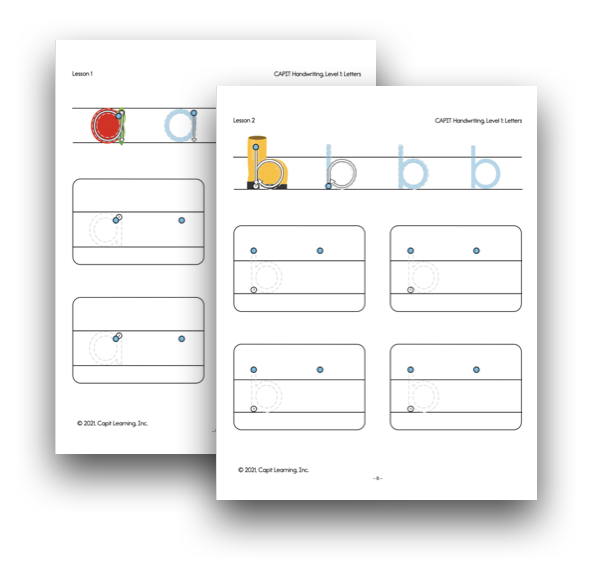
Fig. 2: CAPIT’s Handwriting Worsheets
Our design philosophy aligns with what we know about effective early literacy instruction:
Multimodal learning strengthens retention
Developmentally appropriate expectations support engagement
Accessibility features ensure all students can participate
The goal is mastery of sound-symbol relationships, not perfect penmanship
Students who use CAPIT will have plenty of opportunities to develop fine motor skills and handwriting fluency through other activities in their school day or when using our handwriting worksheets (Fig. 2). Our role is to ensure that fine motor development doesn't become a barrier to learning to read.
References:
James, K. H., & Engelhardt, L. (2012). The effects of handwriting experience on functional brain development in pre-literate children. Trends in Neuroscience and Education, 1(1), 32-42.
Longcamp, M., Zerbato-Poudou, M. T., & Velay, J. L. (2005). The influence of writing practice on letter recognition in preschool children: A comparison between handwriting and typing. Acta Psychologica, 119(1), 67-79.
Xu, Y., Chang, L. Y., & Perfetti, C. A. (2017). The effect of radical-derived semantic, phonological and stroke-count information on Chinese handwritten character production. Computers in Human Behavior, 71, 525-534. https://www.sciencedirect.com/science/article/abs/pii/S0747563217302649